
10 November 2015
Mineral exploration essential for a sustainable economy
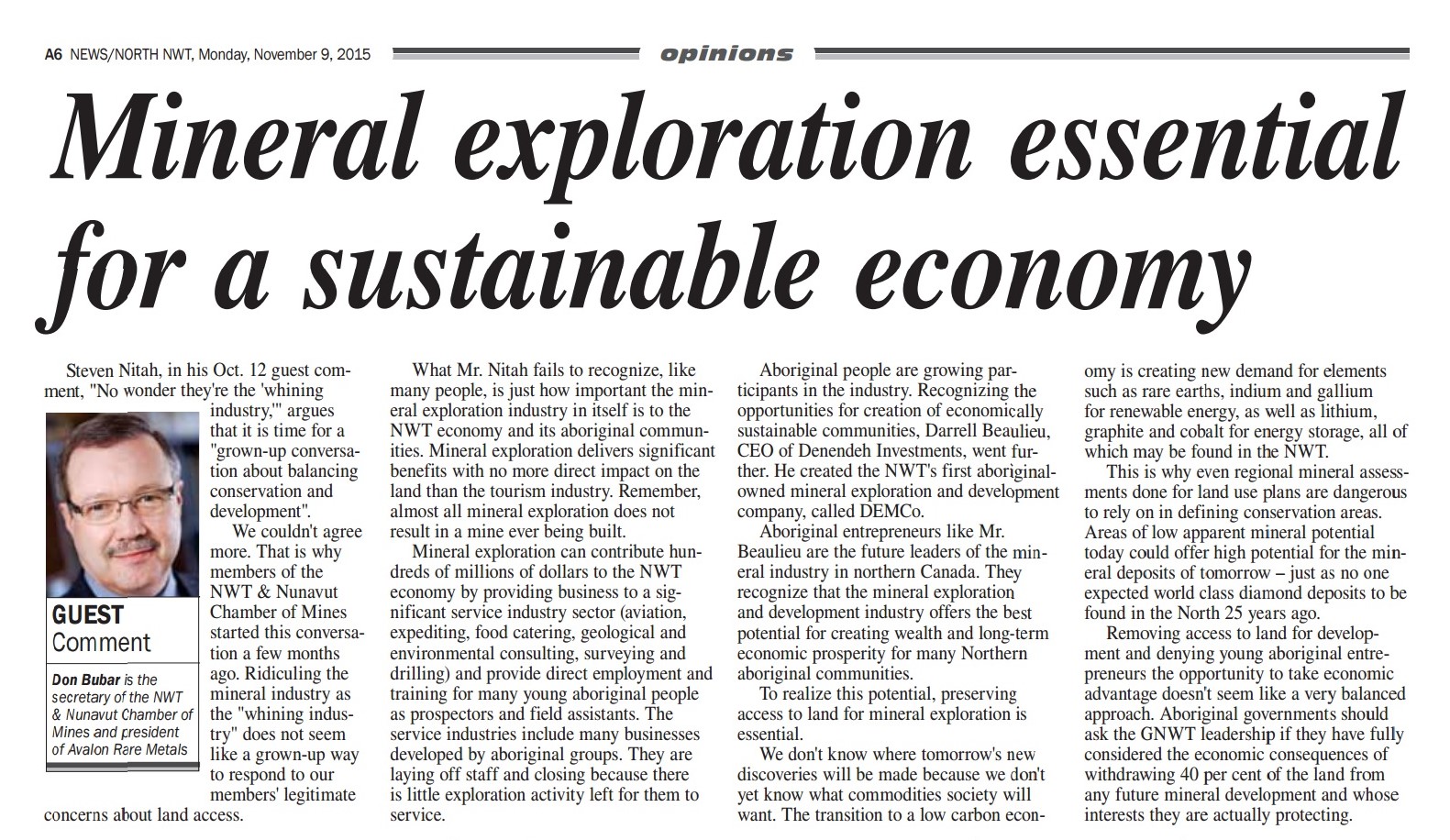
News/North, November 9, 2015, Guest Comment, by Donald Bubar is the secretary of the NWT & Nunavut Chamber of Mines and president, Avalon Rare Metals
Steven Nitah in his October 13 guest comment, “No wonder they’re the ‘whining industry,’” argues that it is time for a “grown-up conversation about balancing conservation and development”.
We couldn’t agree more. That is why members of the NWT & Nunavut Chamber of Mines started this conversation a few months ago. Ridiculing the mineral industry as the “whining industry” does not seem like a grown-up way to respond to our members’ legitimate concerns about land access.
What Mr. Nitah fails to recognize, like many people, is just how important the mineral exploration industry in itself is to the NWT economy and its aboriginal communities, in particular. Mineral exploration delivers significant benefits with no more direct impact on the land than the tourism industry. Remember, almost all mineral exploration does not result in a mine ever being built.
Mineral exploration can contribute hundreds of millions of dollars to the NWT economy by providing business to a significant service industry sector (aviation, expediting, food catering, geological and environmental consulting, surveying, and drilling) and provide direct employment and training for many young Aboriginal people as prospectors and field assistants. The service industries include many businesses developed by aboriginal groups. They are laying off staff and closing because there is little exploration activity left for them to service.
Aboriginal people are growing participants in the industry. Recognizing the opportunities for creation of economically sustainable communities. Darrell Beaulieu, CEO of Denendeh Investments, went further. He created the NWT’s first aboriginal-owned mineral exploration and development company, called DEMCo.
Aboriginal entrepreneurs like Mr. Beaulieu are the future leaders of the mineral industry in northern Canada. They recognize that the mineral exploration and development industry offers the best possibility for creating wealth and long-term economic prosperity for many northern aboriginal communities.
To realize this potential, preserving access to land for mineral exploration is essential.
We don’t know where tomorrow’s new discoveries will be made because we don’t yet know what commodities society will want. The transition to a low carbon economy is creating new demand for elements such as rare earths, indium and gallium for renewable energy, as well as lithium, graphite and cobalt for energy storage, all of which may be found in the NWT.
This is why even regional mineral assessments done for land use plans are dangerous to rely on in defining conservation areas. Areas of low apparent low mineral potential today could offer high potential for the mineral deposits of tomorrow – just as no one expected world class diamond deposits to be found in the North 25 years ago.
Removing access to land for development and denying young aboriginal entrepreneurs the opportunity to take economic advantage, doesn’t seem like a very balanced approach. Aboriginal government should ask the GNWT leadership if they have fully considered the economic consequences of withdrawing 40 per cent of the land from any future mineral development and whose interests they are actually protecting.